CNC Machining for Oil and Gas Components: Materials, Tolerances, and Applications
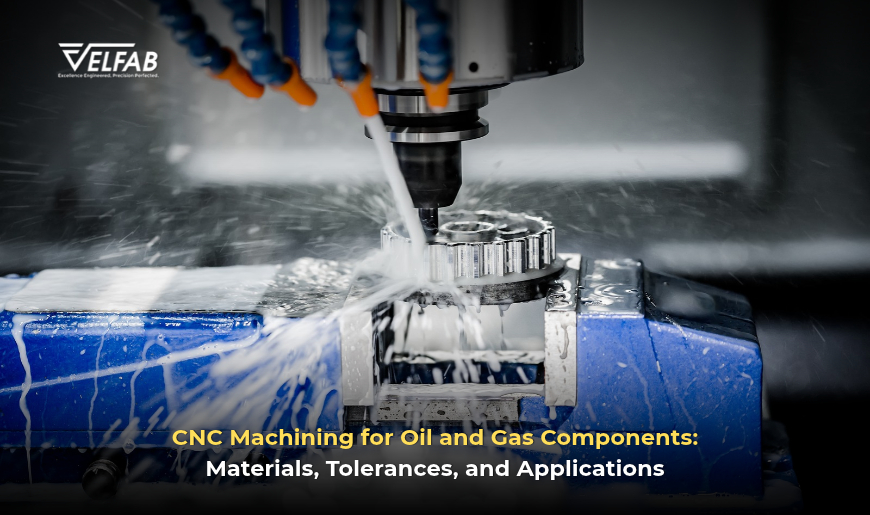
Oil and gas equipment works under intense pressure and high temperatures, often in direct contact with corrosive fluids. Operators depend on CNC machining to make parts that stay accurate and safe in those conditions. From drilling tools to subsea valve assemblies, every machined part plays a role in keeping production running.
Why does the oil and gas industry rely on CNC machining?
CNC machining uses computer controlled tools to cut metal to the exact size on a drawing, part after part. That consistency matters when a component must seal, carry load or control flow in harsh conditions.
It also suits the way the industry orders parts. Some jobs call for a single custom piece for a repair. Others need a full production run. A capable CNC workshop handles both with the same level of accuracy.
What materials are used in oil and gas machining?
Each stage of oil and gas work exposes parts to different conditions, so the alloy changes too. Velfab’s oil and gas machining work covers four main application areas:
| Application | Typical CNC machined components | Materials Velfab uses |
| Drilling and frac | Drill bits, collars, stabilisers, frac pump components | Inconel, super duplex stainless steel |
| Surface | Wellhead parts, high pressure valves, flow control equipment, pressure vessel components | Hastelloy, duplex stainless steel |
| Completion | Casing and tubing hangers, packers, perforating guns | High grade alloys |
| Subsea | Connectors, manifolds, subsea valve assemblies | Titanium, super duplex, corrosion resistant alloys |
These alloys offer durability and corrosion resistance, so parts keep performing in the harshest environments.
How tight are tolerances on oil and gas parts?
A tolerance is how far a size may vary from the drawing. Oil and gas parts carry demanding tolerances, especially on features that seal or connect to other parts.
Velfab works to GD&T standards, which control the shape and position of a feature as well as its size. Our machining holds form errors under 10 to 15 microns, with surface finishes as smooth as Ra 0.2 μm. Ra measures surface roughness, so a lower number means a smoother face.
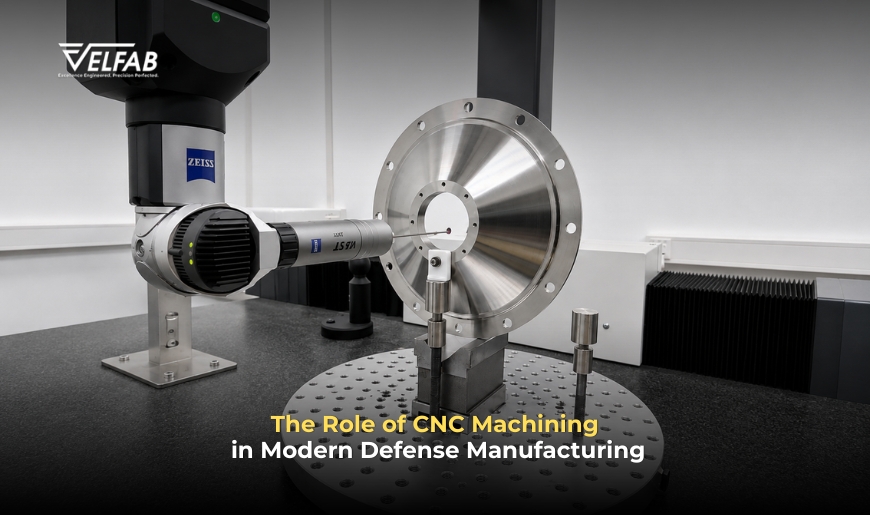
Did you know? Velfab’s inspection room includes a Pfeiffer helium leak detector for leak testing. It sits alongside a Zeiss CMM that measures parts up to 1000 mm x 700 mm x 600 mm.
Types of CNC machines used for oil and gas components
Velfab uses a mix of machines, each suited to a different kind of feature:
- CNC turning: cylindrical parts such as shafts and connectors.
- 5 axis machining: reaches several faces of a part in one setup, which helps hold tighter tolerances on complex shapes.
- CNC boring: accurate internal bores in larger components.
- Wire EDM: cuts detailed shapes using a thin, electrically charged wire.
- Precision grinding: OD grinding for shafts, ID grinding for bores and surface grinding for flat faces.
What makes oil and gas CNC machining challenging?
Tough alloys come first. Inconel, titanium and super duplex are harder to machine than everyday steels, and they demand experienced machinists and specialised tooling.
Complex shapes add to the difficulty. Valve assemblies and manifolds often have several angled ports, which 5-axis machining can reach without moving the part between machines.
Proof of quality is the third hurdle. Operators expect documents for every critical part. Velfab supports this with mill test certificates, first article inspection reports and metallurgical testing. That testing includes positive material identification, ultrasonic testing and dye penetrant testing.
Benefits of precision CNC machining for oil and gas equipment
Accurate machining gives operators practical gains:
- Consistent quality across custom orders and larger production runs.
- Complex shapes made in fewer setups.
- Smooth, accurate sealing and mating surfaces.
- Records that trace each part back to its batch, process and approval.
How to choose a CNC machining company in Australia
Ask these questions before placing an order:
- Is your quality system certified to ISO 9001:2015?
- Can you trace each part back to its batch and mill test certificate?
- What equipment do you use to inspect critical features?
- Have you machined Inconel, duplex and super duplex before?
- Will you supply first article inspection reports?
A capable supplier answers with documents and inspection records.
Partner with Velfab for oil and gas CNC machining
Velfab is a Perth-based precision engineering company. With more than 25 CNC machines across two manufacturing units, we support drilling, surface, completion and subsea applications. Our 5-axis machining, CNC boring and wire EDM handle complex parts in tough alloys.
Our inspection process combines a Zeiss CMM, metallurgical testing and first article inspection. All of it runs under an ISO 9001:2015-certified quality system, with full traceability for every batch.
If you need CNC machining in Australia for critical oil and gas parts, contact Velfab to discuss your drawings and materials.
FAQs
CNC machining uses computer-controlled tools to cut metal parts to exact sizes. In oil and gas, it produces wellhead parts, high-pressure valves, drill collars and subsea connectors that must perform safely under pressure and heat.
Velfab machines Inconel, duplex and super duplex stainless steel, Hastelloy and titanium for oil and gas work. These alloys offer durability and corrosion resistance under high pressure, high temperature and corrosive conditions.
Sealing faces, valve seats and connecting features must fit closely so fluid cannot escape under pressure. Velfab works to GD&T standards with form errors under 10 to 15 microns on precision parts.
Velfab checks critical parts with a Zeiss CMM, surface roughness testing and air gauges for bores. Positive material identification, ultrasonic and dye penetrant testing, plus first article reports, support full traceability.
Look for an ISO 9001:2015 certified quality system, full material traceability, CMM inspection and proven experience with Inconel, duplex and super duplex. Ask for first article inspection reports on critical parts.