
Precision Manufacturing for Semiconductor Equipment: What Tolerances Are Required?
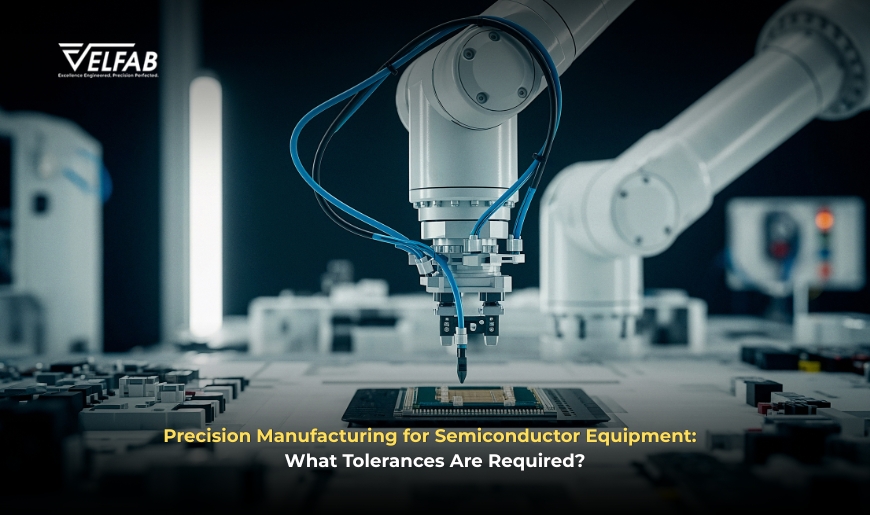
The semiconductor industry depends on extremely high manufacturing accuracy. Semiconductor equipment contains complex assemblies where even small dimensional variations can affect performance, alignment, and production efficiency.
Precision manufacturing is essential for producing semiconductor equipment components that require strict tolerances, excellent surface finishes, and consistent quality.
From wafer processing systems to inspection equipment, every component must meet demanding engineering specifications.
Why Semiconductor Equipment Requires Precision Manufacturing
Semiconductor manufacturing equipment operates in highly controlled environments where accuracy is critical.
Components used in semiconductor systems often require:
- High dimensional accuracy
- Tight geometric tolerances
- Smooth surface finishes
- Material stability
- Clean manufacturing processes
A small manufacturing error can impact equipment performance and affect semiconductor production efficiency.
Understanding Tolerances in Semiconductor Equipment Manufacturing
Dimensional Tolerances
Dimensional tolerance defines how much variation is acceptable in a component’s size.
Semiconductor equipment manufacturers often require extremely controlled dimensions because components must fit together precisely during assembly.
Geometric Tolerances
Geometric accuracy controls features such as:
- Flatness
- Parallelism
- Position accuracy
- Alignment
These factors are important for semiconductor equipment because precise positioning directly impacts system performance.
Surface Finish Requirements
Surface quality is another important factor in semiconductor manufacturing equipment.
Smooth surfaces help reduce:
- Particle generation
- Contamination risks
- Component wear
High-quality finishing processes help maintain equipment reliability.
Materials Used in Semiconductor Manufacturing Equipment
Semiconductor equipment components are manufactured using materials selected for stability and performance.
Common materials include:
- Aluminium
- Stainless steel
- Titanium
- Special alloys
Material selection depends on factors such as thermal stability, corrosion resistance, and application requirements.
How Precision Manufacturing Supports Semiconductor Equipment Production
Precision manufacturing helps semiconductor companies through:
Complex Component Production
Advanced machining allows manufacturers to produce complex geometries required for semiconductor equipment assemblies.
Consistent Quality
Repeatable manufacturing processes ensure every component maintains the required specifications.
Faster Product Development
Precision manufacturing supports prototype production and engineering validation before large-scale manufacturing.
Quality Control Requirements for Semiconductor Components
Quality inspection is essential because semiconductor equipment requires extremely reliable components.
Manufacturers commonly use:
- Coordinate measuring machines
- Precision measurement tools
- Surface inspection systems
- Process documentation
These methods help verify that components meet engineering requirements.
Choosing the Right Precision Manufacturing Partner for Semiconductor Equipment
A suitable manufacturing partner should provide:
- Experience with complex components
- Advanced machining capabilities
- Accurate inspection methods
- Material knowledge
- Reliable production processes
The right supplier helps semiconductor companies maintain equipment performance and production reliability.
Precision Manufacturing Solutions by Velfab
Velfab provides advanced manufacturing solutions for industries requiring high-accuracy components and complex engineering requirements.
With expertise in precision machining, quality inspection, and advanced manufacturing processes, Velfab supports companies developing critical industrial equipment.
For semiconductor equipment manufacturers seeking reliable component production, Velfab delivers precision-focused manufacturing solutions.
Connect with Velfab for your precision manufacturing requirements.
FAQs
Precision manufacturing ensures semiconductor components meet strict accuracy requirements needed for reliable equipment operation.
Tolerance requirements vary by application, but semiconductor components generally require highly controlled dimensional and geometric accuracy.
Common materials include aluminium, stainless steel, titanium, and engineered alloys.
Components are inspected using measurement systems such as CMM, dimensional inspection tools, and surface testing methods.
Yes, experienced manufacturers can support prototype development and low-volume production for semiconductor applications.