Titanium CNC machining: grades, cutting challenges, and why it demands specialized tooling
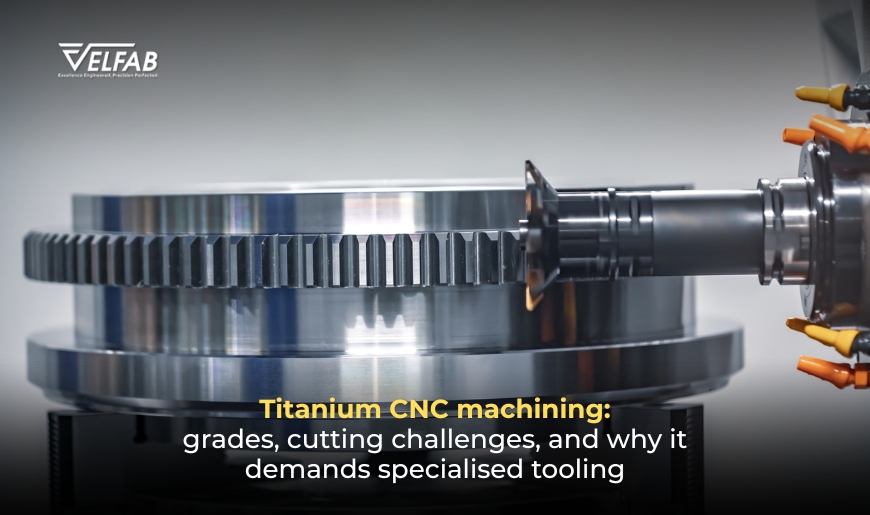
Titanium sits at the top of the difficulty scale in CNC machining. It is strong, light, and highly corrosion resistant. These qualities make it essential in aerospace structures, medical implants, marine equipment, and industrial components. They also make it genuinely hard to cut.
Understanding titanium before approaching it on a machine is not optional. It is necessary.
Titanium Grades and Their Differences
Titanium is not a single material. It comes in multiple grades, each with distinct mechanical properties and machining behaviour.
Grade 1 and Grade 2 are commercially pure titanium. They are softer and more ductile. Medical and chemical processing applications often use these grades due to their high corrosion resistance and biocompatibility.
Grade 5, known as Ti-6Al-4V, is the most widely used alloy in CNC machining titanium. It combines high strength with good fatigue resistance and is common in aerospace components, surgical devices, and structural parts. Grade 5 is significantly harder to machine than commercially pure grades.
Grade 23, also Ti-6Al-4V but with tighter impurity controls, is used specifically in implantable medical devices. Precision titanium machining for this grade requires strict process control to meet biocompatibility standards.
Higher-strength grades such as Ti-5Al-5V-5Mo-3Cr are used in demanding aerospace and defence applications. These are among the most difficult titanium alloys to machine and require highly capable equipment.
Why Titanium Is Hard to Machine
Several properties combine to make titanium machining challenging. First, titanium conducts heat poorly. In most metals, heat generated during cutting disperses into the workpiece and the chip. In titanium, heat concentrates at the cutting edge. This accelerates tool wear dramatically.
Second, titanium has a strong tendency to work harden. If the tool dwells on the surface without cutting effectively, the material hardens in that zone. Subsequent passes then encounter a harder surface than the original material.
Third, titanium is chemically reactive at high temperatures. It can weld to cutting tool surfaces in a process called built-up edge formation. This alters the tool geometry and degrades surface finish on the precision CNC parts being produced.
Finally, titanium is springy. It deflects under cutting forces and springs back after the tool passes. This affects dimensional accuracy, especially in thin walls and unsupported features.
Tooling Requirements for Titanium
Standard high-speed steel or general-purpose carbide tooling is not suitable for production titanium machining. Titanium machining tools must be selected with specific characteristics in mind.
Solid carbide end mills with sharp cutting edges and high positive rake angles reduce cutting forces and minimise heat buildup. Tool coatings such as TiAlN and ZrN improve heat resistance at the cutting zone without promoting adhesion between the tool and the titanium workpiece.
Cutting speeds for titanium are deliberately low compared to aluminium or steel. Slowing the spindle reduces heat generation. Feed rates, however, are maintained to keep the tool actively cutting and prevent dwelling on the surface.
Coolant is not optional. High-pressure coolant delivery directly to the cutting zone is standard practice in CNC machining Australia for titanium applications. It removes heat, flushes chips, and extends tool life significantly.
Precision CNC Machining Strategies for Titanium
Successful titanium machining uses consistent chip load, avoids interrupted cuts where possible, and plans tool paths to minimise material contact time without sacrificing accuracy.
Trochoidal milling, where the tool follows a curved path rather than a straight slot, keeps consistent radial engagement and reduces peak cutting loads. This approach extends tool life and maintains dimensional control on complex geometries.
Fixturing also matters more with titanium. The springiness of the material requires rigid workholding. Any vibration in the setup amplifies surface irregularities and increases the risk of tool failure.
CNC machining in Australia for titanium components is most effective when it combines the right machine capability, appropriate tooling, sound process planning, and experienced operators who know how the material behaves.
Conclusion
Titanium machining demands far more than standard CNC capability. Its heat concentration, work hardening behaviour, and material deflection create challenges that require specialised tooling, advanced machining strategies, and experienced operators. From aerospace components to medical implants, precision titanium machining depends on maintaining tight tolerances, controlled cutting conditions, and consistent surface quality.
Successful CNC machining titanium is achieved when the right combination of machine capability, tooling selection, coolant delivery, and process expertise comes together to produce reliable precision CNC parts with long term performance.
At Velfab Precision Machining, we deliver high accuracy titanium CNC machining solutions for demanding industrial applications. Our advanced CNC machining capabilities, precision tooling strategies, and commitment to quality help manufacturers achieve reliable performance across complex titanium components.
FAQs
Titanium generates concentrated heat and causes rapid tool wear during machining.
Grade 5 titanium is the most widely used alloy for aerospace and industrial applications.
Specialised tools help reduce heat buildup, improve cutting stability, and extend tool life.
High pressure coolant systems are commonly used to control heat and remove chips effectively.
Aerospace, medical, marine, defence, and industrial sectors frequently use titanium components.