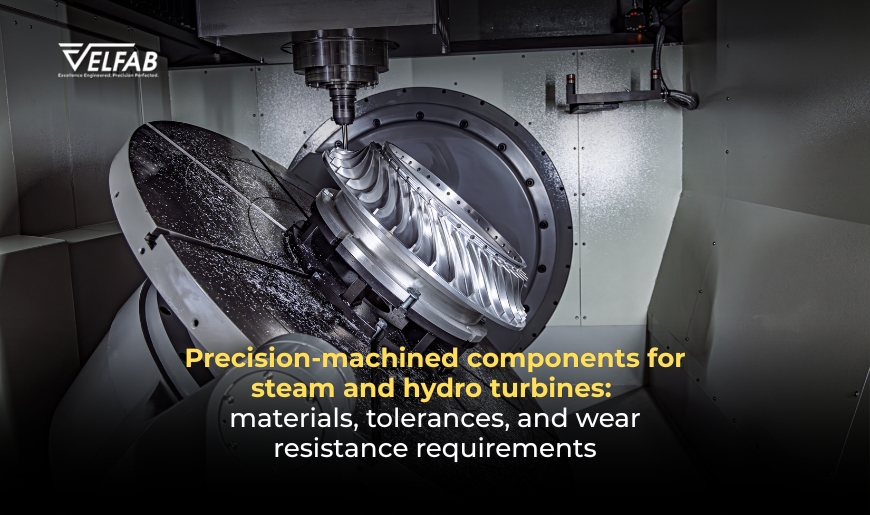
Precision-machined components for steam and hydro turbines: materials, tolerances, and wear resistance requirements
Turbines do not forgive errors. Steam and hydro turbines operate under extreme pressures, high rotational speeds, and thermal cycles that push every component to its limit. When a part fails, the cost goes far beyond replacement.
Precision machined components are what keep these machines running reliably. Understanding the requirements behind them helps engineers, procurement teams, and plant operators make better decisions.
Why Material Selection Matters
The choice of material is the foundation of every turbine component. Steam turbines expose parts to superheated steam that can exceed 600 degrees Celsius. Hydro turbines face a different challenge. Constant water contact creates conditions for corrosion, cavitation, and erosion over time.
Stainless steels such as 316L and duplex grades are widely used in hydro turbine runners and guide vanes. They offer strong corrosion resistance without sacrificing structural integrity. For steam turbines, alloy steels and nickel-based superalloys are preferred where high temperature strength is required.
Precision manufacturers in Australia working on power generation components must understand these material behaviours deeply. A wrong alloy choice affects not just durability but also machinability and dimensional stability during heat treatment.
Tolerances in Turbine Components
Turbine efficiency depends on how closely parts conform to design specifications. Even a small deviation in blade geometry changes the aerodynamic profile and reduces output. Bearing journals and shaft fits require extremely tight tolerances to prevent vibration and maintain alignment at operating speed.
Precision machining for turbine parts commonly involves tolerances in the range of plus or minus 0.005 millimetres or tighter. CNC machining centres with multi-axis capability and real-time measurement systems make these tolerances achievable consistently.
Surface finish also plays a direct role. Roughness values on sealing faces and flow passages must meet strict requirements. A poorly finished surface creates turbulence, reduces efficiency, and increases wear over time.
Wear Resistance Requirements
Wear is a constant threat in both steam and hydro environments. Solid particles carried in steam or water strike component surfaces repeatedly, leading to erosion. In hydro turbines, cavitation damage occurs when vapour bubbles collapse near metal surfaces with enough force to pit the material.
Hard coatings such as tungsten carbide or ceramic thermal spray are applied to high-wear zones. The base material must still be properly machined before coating to ensure adhesion and dimensional accuracy are maintained after the coating process.
Precision machined components must also allow for controlled replacement. Wear parts are often designed with repeatable interfaces so they can be swapped during planned maintenance without full teardown.
The Role of Precision Manufacturing
Not every machine shop can meet turbine component requirements. Precision manufacturing for the energy sector requires controlled environments, verified tooling, traceable measurement, and experienced operators who understand the consequences of deviation.
Australian precision manufacturers serving the hydro and steam sectors have developed competencies in both high-volume repeat components and low-volume complex parts. Quality systems aligned with ISO standards ensure consistency across production runs.
Every component that enters a turbine assembly carries the weight of the entire system behind it. Precision machining is not just a manufacturing step. It is a direct input into plant reliability and long-term operational cost.
Conclusion
Steam and hydro turbines demand exceptional accuracy, material reliability, and long term wear resistance. From alloy selection to micron level tolerances, every detail influences operational efficiency and equipment lifespan. Precision machined components help reduce vibration, improve sealing performance, and support reliable energy generation under extreme operating conditions.
As turbine systems continue to evolve, the importance of advanced precision manufacturing becomes even greater. High quality machining is not only about producing parts accurately. It is about ensuring reliability, safety, and consistent plant performance for years of operation.
At Velfab Precision Machining, we manufacture high precision machined components engineered for demanding industrial applications including steam and hydro turbines. Our advanced CNC machining capabilities, strict quality control processes, and commitment to precision help industries achieve reliable performance and long service life.
FAQs
Tight tolerances help maintain alignment, reduce vibration, and improve turbine efficiency.
Stainless steel, alloy steel, duplex steel, and nickel based alloys are widely used for turbine applications.
Heat, pressure, erosion, cavitation, and continuous particle impact contribute to turbine wear.
Precision machining ensures accurate component fit, smoother operation, and reduced maintenance issues.
Wear resistant coatings help protect components from erosion, corrosion, and surface damage during operation.