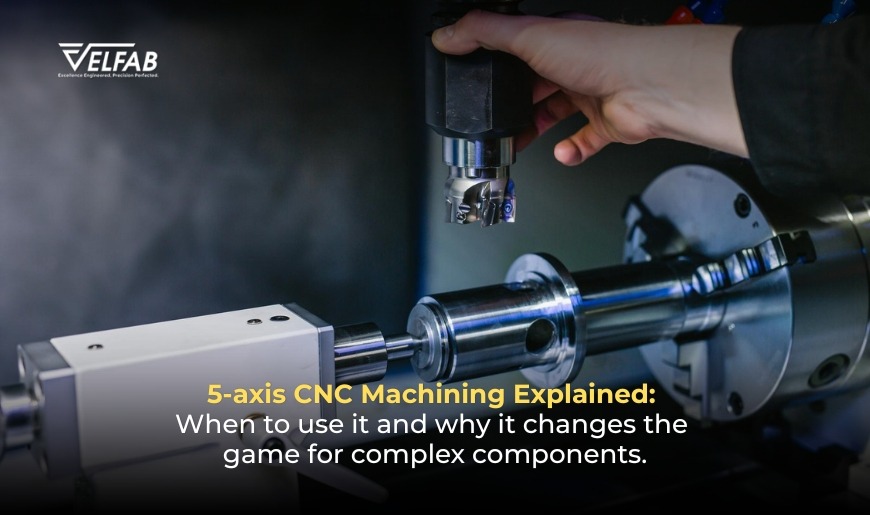
5-axis CNC machining explained: when to use it and why it changes the game for complex components
Understanding the Axes in CNC Machining
CNC machining uses computer-controlled cutting tools to shape raw material into finished parts. The number of axes defines how many directions the cutting tool and workpiece can move at the same time.
A standard 3 axis machine moves in three directions. Left and right, front and back, and up and down. This works well for flat surfaces, pockets, and holes. Many general engineering components are produced this way.
A 5 axis machine adds two rotational movements to these three directions. The cutting tool or table can tilt and rotate while cutting. This allows the tool to approach the part from almost any angle without stopping.
Think of it like carving a sculpture. With a 3 axis setup, you stop and rotate the piece manually. With a 5 axis setup, you continue cutting from multiple angles in one smooth process.
What Makes 5 Axis Machining Different
The main difference is continuous access. In 3 axis machining, parts with angled features need to be repositioned. Each repositioning increases the chance of small alignment errors.
5 axis machining reduces or removes this need. The part stays in one position throughout the process. This maintains a single reference point and improves dimensional accuracy.
Surface finish also improves. The cutting tool maintains an optimal angle while cutting. This produces a cleaner and more consistent finish. It also reduces the need for extra processing.
Shorter cutting tools can be used. Long tools in 3 axis setups may bend under pressure. In 5 axis machining, the part is tilted instead. This allows the use of shorter and more stable tools.
When 5 Axis Machining Delivers Real Value
Not every component needs 5 axis machining. Simple parts like flat plates or brackets are better suited for 3 axis machines. Using advanced machining for simple work increases cost without benefit.
5 axis machining becomes valuable when parts have complex shapes. Features like curves, undercuts, and angled holes require this capability. Components such as turbine housings, impellers, and medical parts depend on it.
It also reduces lead time. A part that needs multiple setups on a 3 axis machine can often be completed in one or two setups. This saves time and reduces handling risks.
Consider a manifold with ports on different faces. A 3 axis machine requires multiple setups. A 5 axis machine completes the same work in one setup. The result is faster production and better accuracy.
Industries That Rely on 5 Axis Machining
Aerospace uses 5 axis machining for complex and high precision components. These include structural frames and engine parts. Tolerances in this industry are very strict.
The defence sector also depends on it. Components must meet exact standards and perform reliably.
Medical manufacturers use it for implants and surgical tools. These parts require smooth surfaces and precise shapes that match the human body.
Oil, gas, and marine industries use it for parts like valve bodies and connectors. These components must perform in harsh environments.
Real World Example from Agriculture
Think of a farmer preparing land for sowing. If the field is uneven, crops may not grow well. But when the soil is prepared evenly in one process, results improve.
In the same way, machining a part in one setup improves consistency and performance.
5 Axis Machining in Perth and Across Australia
Australian manufacturers are adopting 5 axis machining to meet global standards. Facilities in Perth and other regions are equipped for complex component production.
Working with a local supplier offers practical benefits. Engineers can review parts in person and collaborate easily. Shorter supply chains also reduce delays and risk.
Choosing the Right Supplier for 5 Axis Work
A machine alone does not guarantee quality. Programming skills, tooling knowledge, and quality control are equally important.
Ask suppliers about their experience with similar components. Review past work and check their inspection process.
For aerospace and defence, certifications like AS9100 are important. They show that the manufacturer follows strict quality systems.
Final Thoughts
5-axis CNC machining is a powerful solution. It is not required for every part. But for complex designs and tight tolerances, it offers clear advantages.
Understanding when to use it helps improve efficiency and product quality. Choosing the right manufacturing partner ensures consistent results.Looking for high precision CNC machining solutions for complex components
Work with experts in 5 axis machining Perth to achieve accuracy and consistency
Explore more at Velfab.
FAQs
It is an advanced machining process where the tool moves in five directions, allowing complex parts to be produced in a single setup with high accuracy.
It is best for components with complex shapes, angled features, and tight tolerances that require high precision.
It reduces the need for multiple setups, which minimizes alignment errors and maintains consistency throughout the process.
Yes, it reduces setup time and handling, which improves overall production speed for complex components.
Aerospace, medical, defence, and energy industries rely heavily on this technology for precision components.